Equitable Land Access for Food Growing

Access to land for food growing in the Capital Region is limited due to rising land costs, competing land uses, and ongoing systemic barriers that disproportionately impact new and equity-denied growers. While interest in local food production, cultural food growing, and community-based agriculture is growing, pathways to secure, affordable, and appropriate land, are a primary challenge which significantly limits the region’s ability to advance food security, food sovereignty, climate resilience, and inclusive economic participation.

The Equitable Land Access initiative, led by Iye Creative and CRFAIR in partnership with community, government, and regional actors, focuses on improving access to land for food growing through research, community engagement, demonstration and policy development. The project identifies barriers and opportunities within municipal and regional systems, with a particular focus on equity denied groups, advances practical tools and policy recommendations, and supports communities and local governments to activate underutilized public land for food production. This work contributes to a more coordinated, transparent, and equitable approach to land access across the region.
Here you will find reports and resources from the project as well as information about different pathways to land access, with an emphasis on public land. These resources are divided into three sections:
I want to access land ⤵️
I want to understand the issue ⤵️
I want to create change ⤵️

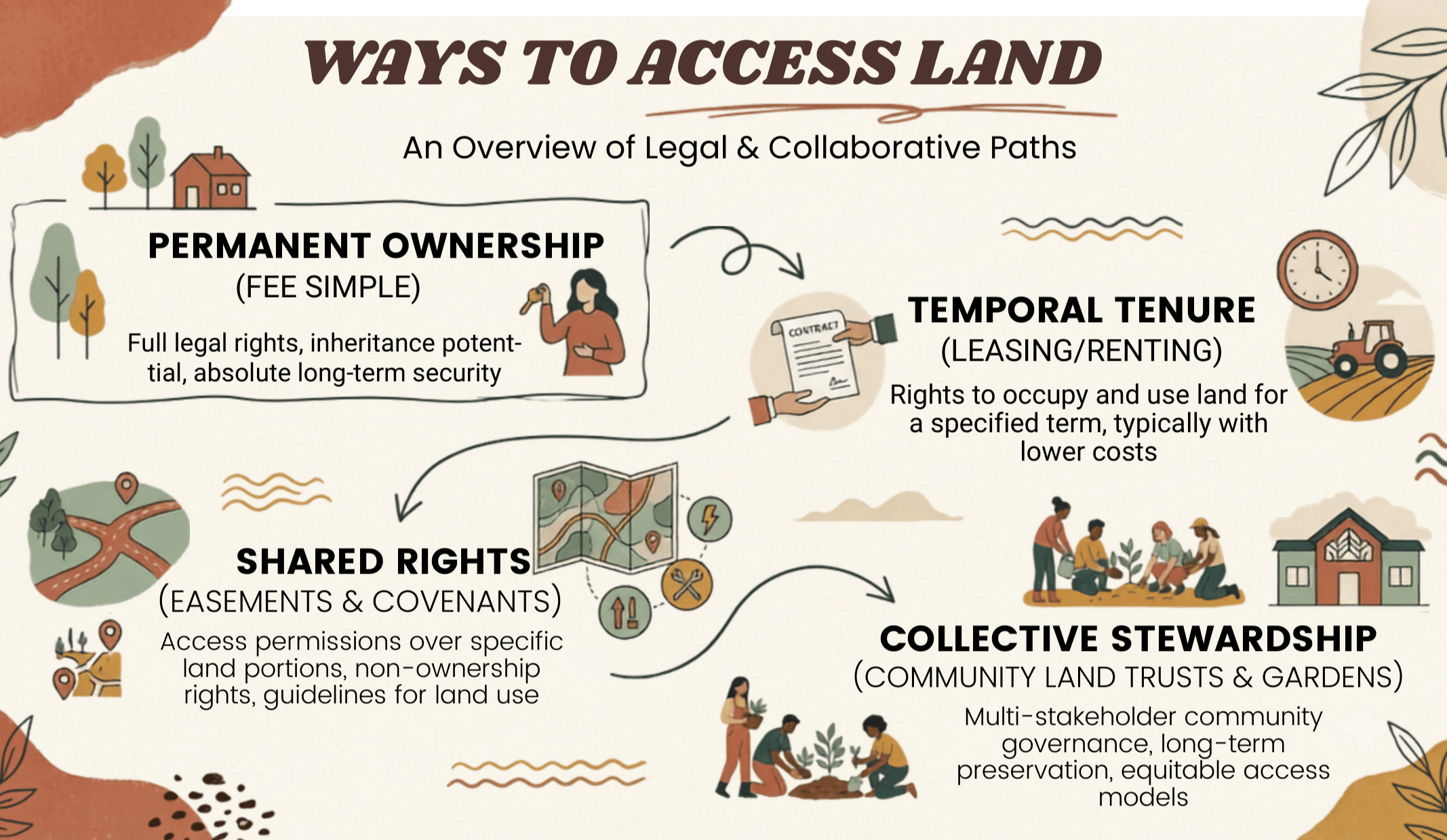
Ways to Access Land
Accessing land can take various legal and collaborative forms depending on whether the security of tenure needed is permanent, temporary, or collective. Permanent paths include complete ownership through Fee Simple/Freehold Interests, inheritance, gifts, or purchases. For shorter-term or seasonal security, Leaseholds grant the right to occupy land for designated periods. Additionally, specialized arrangements like Easements grant infrastructure or access paths across properties, while Covenants dictate permitted land uses. Collectively, community-driven models like Community Land Trusts, community gardens, and public land allocations provide equitable frameworks to steward land sustainably and culturally.
Land Access Pathways

Check back soon!

Advocate as a community member
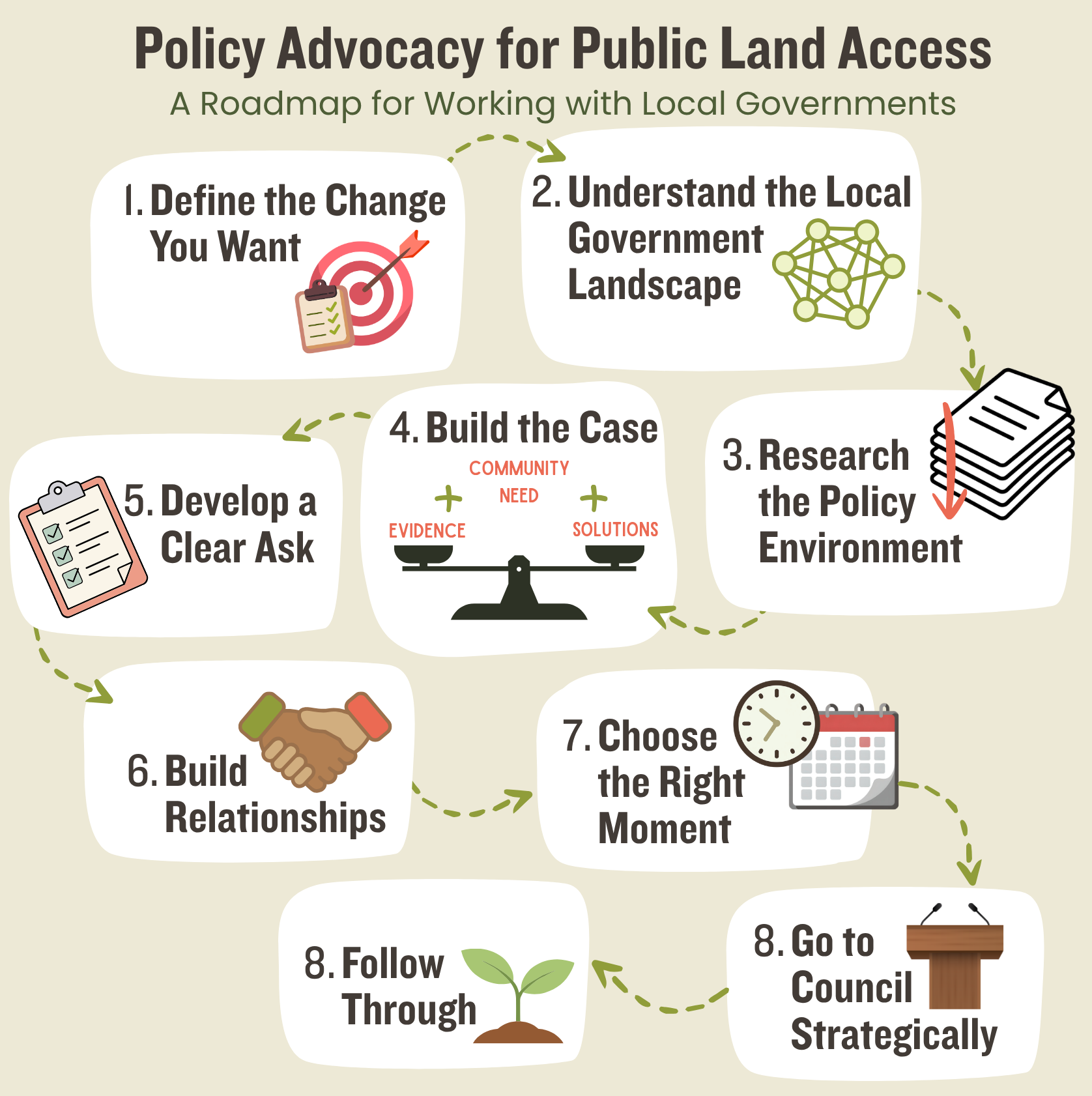
How to work with local government to unlock public land
Effective policy advocacy for increasing access to public land requires a strategic and relationship-based approach that connects community needs with local government priorities and decision-making processes. Successful advocacy begins with clearly defining the desired policy or land access outcome, understanding which level of government and decision-makers hold authority, and researching how the issue aligns with existing municipal plans, policies, and public priorities.
Strong advocacy efforts build a compelling case by combining evidence, community stories, and clear public benefits, while developing a specific and actionable policy ask. Building relationships with staff, community allies, and decision-makers early in the process is critical, as is understanding the right timing for engaging council or participating in policy processes.
Effective advocates present practical solutions, remain engaged throughout implementation, and recognize that meaningful policy change often requires sustained collaboration, persistence, and long-term community organizing.
Overview sentence about advocacy toolkit — click here to explore ➡️
Advocate as a member of government
What can local governments do?
Based on the research and policy analysis conducted through the Equitable Land Access Initiative, local governments have a significant role to play in advancing equitable access to public land for food growing, cultural practices, and community well-being. The reports emphasize that municipalities can move beyond passive support for community gardens toward actively embedding equity into land use planning, policy development, public land allocation, and food systems planning. Recommended actions include updating policies with an explicit equity lens, identifying and releasing appropriate public lands for community food growing, integrating community gardens into parks and public spaces, reducing financial and procedural barriers, supporting culturally safe and inclusive spaces, and creating clearer pathways for community groups to access land. The research also highlights the importance of establishing advisory structures and participatory processes that include Indigenous Nations, racialized communities, newcomers, and equity-denied groups in decision-making processes related to land use and food systems planning.
Support greater equity & inclusion in land access for food growing
Nancy Nyandika’s research further identified that equity-denied groups face distinct and interconnected barriers that are often overlooked within conventional land access policies and planning systems. These barriers include high land and housing costs, complex and inaccessible municipal application processes, limited understanding of political and land-use systems, lack of culturally safe growing spaces, language barriers, underrepresentation in decision-making, and the lasting impacts of colonization, displacement, and systemic discrimination.
The research found that many racialized, newcomer, Indigenous, and immigrant communities experience exclusion from existing community garden and land access systems, with some participants describing feeling unwelcome or unable to fully express their cultural identities within mainstream gardening spaces.
Community members emphasized the importance of culturally safe land access that allows for the growing of culturally significant foods and medicines, supports intergenerational knowledge sharing, and strengthens cultural identity and belonging. The reports recommend that local governments respond through targeted supports such as micro-grants, fee waivers, mentorship programs, multilingual outreach, culturally responsive engagement processes, Indigenous partnership frameworks, and equity-focused public land allocation processes.
The research also suggests that local governments can strengthen long-term equity outcomes by creating dedicated staff capacity, embedding equity metrics into food and agriculture planning, supporting community-led stewardship models, and building long-term partnerships with Indigenous Nations and IBPOC community organizations. These approaches recognize that equitable land access is not only about physical access to land, but also about addressing structural inequities, supporting cultural connection, and creating inclusive systems that allow diverse communities to participate meaningfully in shaping local food and land futures.

Get in touch
Email: engagement@crfair.ca
Subscribe to Network Newsletter
This Project was carried out with generous support from the